
Even on mornings when you feel you barely slept, you may in fact have slept. This “sleep state misperception” is surprisingly common among people who seek help for insomnia. Based on what I’ve learned from a sleep specialist, I’ll explain what sleep state misperception is and why it matters to know your own sleep objectively.
Introduction
Let me say up front that this article was written by someone inside Medisense Inc. Medisense is an app startup founded by a sleep specialist, and in November 2025 we released an app called Sleepa. I’m Masa, an engineer and one of Medisense’s co-founders.
Our CEO runs his own clinic in Hyogo Prefecture, Japan, and is also affiliated with Tohoku University School of Medicine, where he does research and clinical work as a neurologist. Sleep is his particular specialty.
We’ve written on note (in Japanese) about how we turned his expertise into an app and started the company. Today, I’d like to talk about how insomnia and sleep disorders are actually treated, as far as I understand it from his lectures.
How Sleep Disorders and Insomnia Are Actually Treated
There is a clinic I know of that sees patients with severe insomnia who haven’t found help anywhere else, so much so that the doctor there calls it a “last-resort clinic.” So what kind of treatment is offered there?
Mostly, it is counseling. And the doctor spends 30 or 40 minutes, sometimes even longer, with each patient.
Some patients do have an abnormality somewhere in the brain that keeps them from sleeping, but there aren’t many of them. In the doctor’s view, more than half of the cases called “insomnia” are actually sleep state misperception.
Sleep state misperception is a condition in which you feel you haven’t slept, even though you actually have.
There seem to be various reasons why this happens. Here is one example.
A Case of Sleep State Misperception
Even in normal sleep, it is common for brain waves to show brief moments of wakefulness. (They last only an instant, and the sleeper is barely aware of them.) In some cases of sleep state misperception, people perceive the time between these awakenings as time spent awake too, and believe they didn’t sleep at all.
This is sleep state misperception: the person is actually sleeping without any problem. According to the doctor, sleeping pills aren’t needed in such cases. What is needed is to help the patient understand and accept, based on objective evidence, that this is sleep state misperception. As treatment, that is enough.
I said “enough,” but this is actually the hardest part. If a doctor simply says, “You’re actually sleeping. You don’t need sleeping pills,” without any evidence, the patient won’t be convinced, and their symptoms won’t improve. What matters most is to show objective data, and then for doctor and patient to talk things through and build enough trust that the patient believes what the doctor says. That itself is the treatment.
Sleep State Misperception and Sleepa
Now, if you’ll allow me a little self-promotion… Sleepa, from Medisense Inc., is an app we developed with a focus on the gap between feeling that you haven’t slept and how you actually slept.
Sleepa shows the sleep recorded by your Apple Watch in a sleep graph like this one. (This is a sample screen from the Japanese version of the app.)
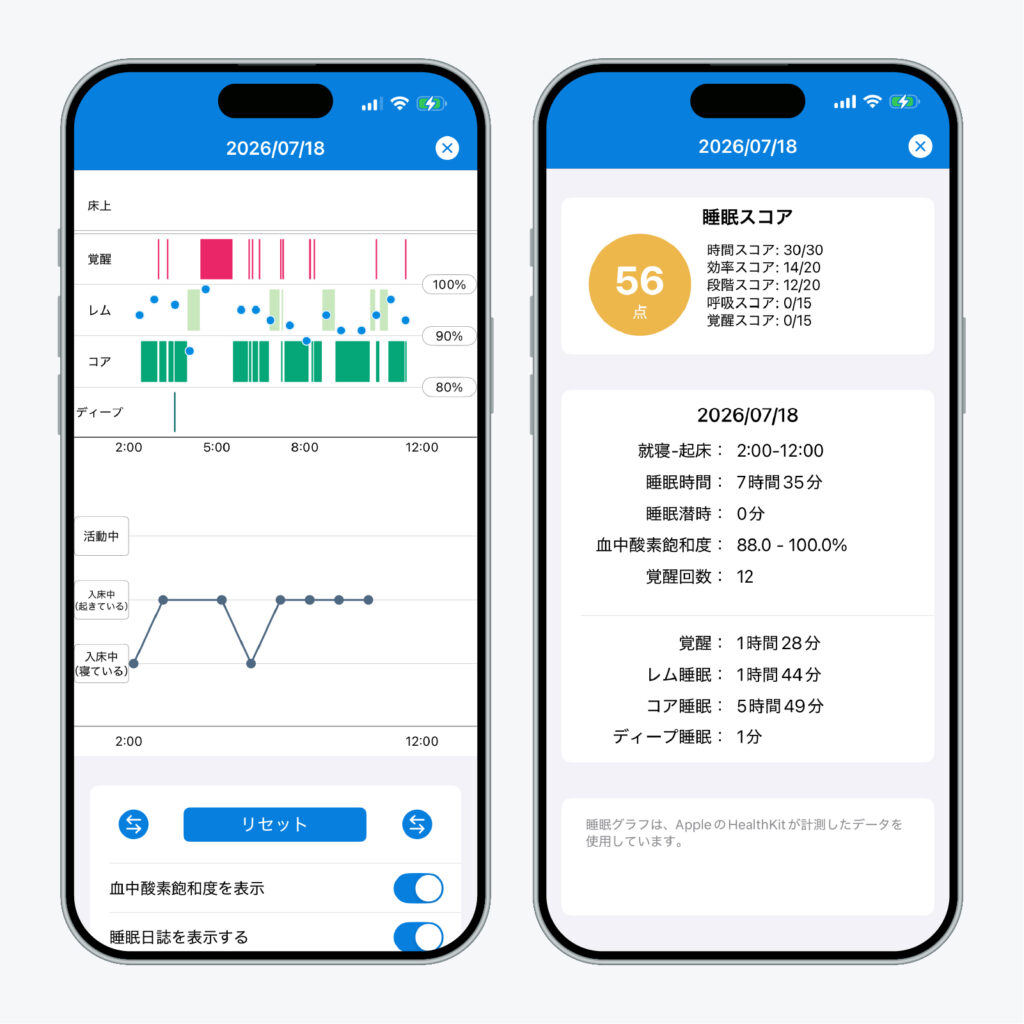
The red lines in the “Awake” row of the graph are awakenings. You can see that many short awakenings were recorded during the night. In cases of sleep state misperception, the time between these awakenings is felt as time spent awake.
Sleepa also has a Sleep Journal for recording how you felt you slept: you give last night’s sleep a score from 1 to 10 and mark, hour by hour, whether you were active, in bed awake, or in bed asleep. You can show the journal on the same timeline as your Apple Watch sleep graph, which makes it easier to notice any gap between the sleep you feel you got and the sleep you actually got.
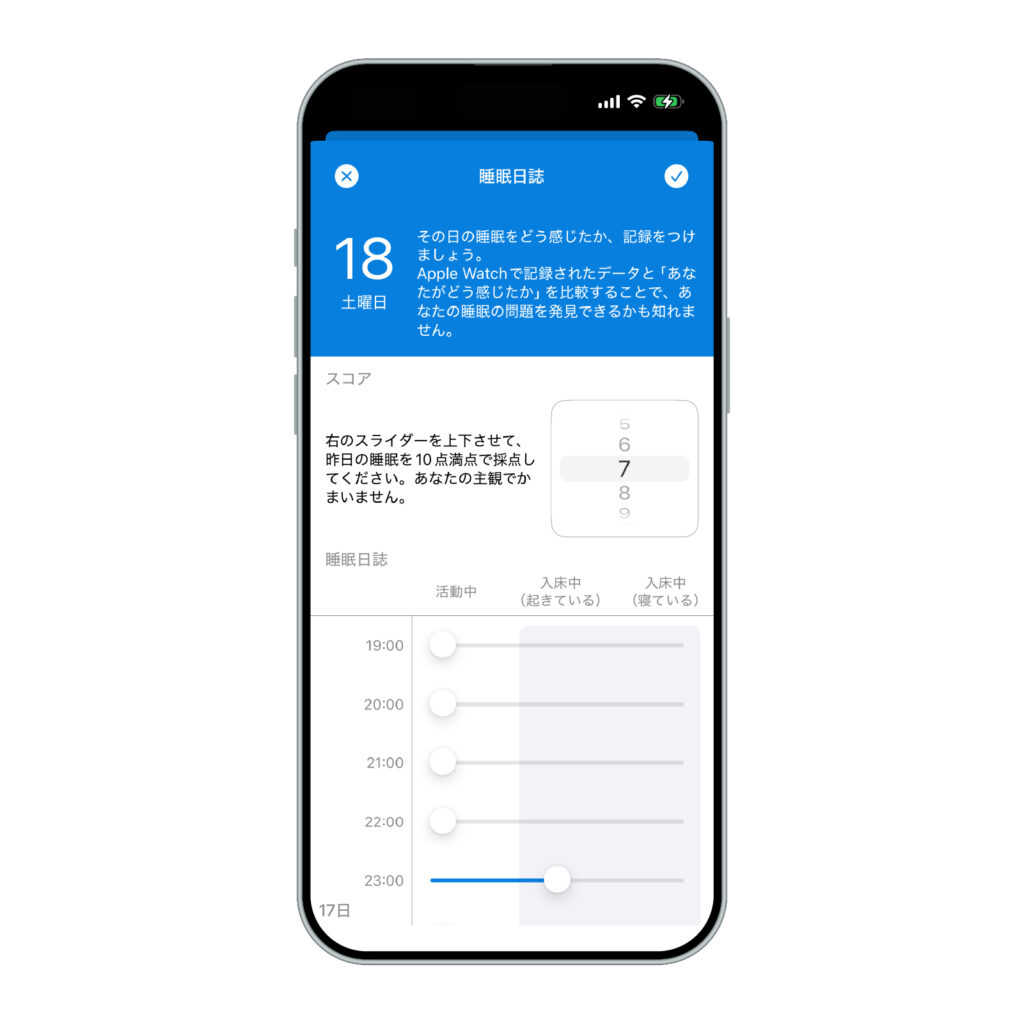
In clinical practice, there are very few ways to monitor a patient’s sleep objectively like this. As a result, sleeping pills are usually prescribed based only on what patients say in consultations, and symptoms often fail to improve. We developed Sleepa to tackle this problem.
To Anyone Struggling with Insomnia or Sleep Disorders
Not everyone who struggles with insomnia or a sleep disorder has sleep state misperception. Still, it is best to get an accurate picture of your condition before starting treatment. Treatment for an illness begins once tests have shown that you have it.
Among people troubled by sleep problems, there are also many who, for example, want better sleep to perform better at work, or who live with a mental health condition such as depression. I’d like to cover these cases in a future article.
Either way, start by getting an objective picture of your sleep. You start a diet after stepping on the scale. Cancer treatment begins once tests have confirmed cancer. So why not start by using Sleepa to get to know your sleep?
Medisense Inc., the company behind Sleepa, is a young startup. If you have feedback or need support, please feel free to reach out through our contact page. Thank you for your support.
Sleepa — The Science of Sleep
Review the sleep data from your Apple Watch together with AI sleep analysis and your sleep journal. Learn more about Sleepa.

*Requires an iPhone with iOS 26 or later and an Apple Watch (Series 6 or later).
Please note: This app is not a medical device. Analysis results are for reference only and are not a medical diagnosis. If you have symptoms that concern you or are worried about your sleep, please consult a healthcare professional.