
When sleepless nights pile up and you finally see a doctor, you may walk out with a prescription for sleeping pills. They can bring real relief from insomnia. But before you start taking them, there is one thing worth checking: are you really not sleeping?
About this article
This article is written by Masa, an engineer and co-founder of Medisense Inc., the company that develops the sleep app Sleepa. It is based on what I have learned from Dr. Norihisa Kimura, who heads Medisense and specializes in sleep (board-certified neurologist; Certified Physician, Japanese Society of Sleep Research). You can read more about him in Why a sleep doctor built a sleep app.
Insomnia is mostly diagnosed by conversation alone
If you have a fever, you can take your temperature. If you are worried about blood pressure, you can measure it. Sleep, however, has no simple gauge a doctor can use in the exam room.
When you see a doctor about insomnia, they start by asking questions. When did you go to bed, and when did you fall asleep? How many times did you wake up? Are you sleepy during the day? Most of what the doctor has to go on is your own memory and impression of your nights.
There is a test that measures sleep objectively: polysomnography (PSG), which records brain waves and more over a full night. But it is a major test, usually done overnight at a sleep lab, and not something that can be done every time someone comes in with insomnia. So in practice, insomnia is usually diagnosed by conversation alone, without any objective data.
As a result, sleeping pills are sometimes prescribed when they aren’t needed
When a patient says “I hardly sleep at all,” the doctor has no way to check. The patient is clearly struggling, and appointment time is short. In that situation, a prescription for sleeping pills is often the easiest thing to offer.
Dr. Kimura sees this, sleeping pills being prescribed even in cases where they aren’t really needed, as one of the biggest problems in sleep care today.
About half of insomnia is sleep state misperception
According to Dr. Kimura, about half of the people who come to him with insomnia have sleep state misperception (sometimes called paradoxical insomnia): they actually sleep a fair amount, but feel as if they don’t.
Even healthy sleep includes many brief awakenings during the night. Most are so short that we never remember them. But if the time between those awakenings also feels like being awake, the whole night can feel sleepless.
In Dr. Kimura’s view, people with sleep state misperception don’t need sleeping pills. What they need is to see, from objective data, that they are in fact sleeping, and to be convinced of it. You can read more in What is sleep state misperception?
Unnecessary sleeping pills don’t lead to good outcomes
For people who need them, sleeping pills are important treatment. But taking them when you don’t need them comes with real downsides:
- The problem doesn’t go away: if the real issue is a gap in how you perceive your sleep, deeper sleep from a pill won’t necessarily make the feeling of “I’m not sleeping” go away. Feeling that the pills don’t work, some people end up taking more of them, or more kinds.
- Side effects: drowsiness or unsteadiness can linger into the next morning, and in older adults this can lead to falls.
- They can be hard to stop: a widely used group of sleeping pills, benzodiazepine receptor agonists (benzodiazepines and the related “Z-drugs”), can cause dependence with long-term use even at approved doses. When the dose is lowered or stopped, withdrawal symptoms such as insomnia and anxiety can appear. Japan’s Pharmaceuticals and Medical Devices Agency (PMDA) has been warning about this since 2017.
- The real cause can be missed: poor sleep can come from another condition, such as sleep apnea or depression. Even if a pill makes you feel you slept, it doesn’t treat the underlying condition, and some sleeping pills can make sleep apnea worse.
Get an accurate diagnosis before treatment
For most physical conditions, doctors confirm what is going on before starting treatment. Insomnia should be no different. Is it sleep state misperception, real lack of sleep, or another condition in disguise? The right treatment is completely different in each case.
Japan’s 2013 clinical guideline on the appropriate use and discontinuation of sleeping pills, compiled by a Ministry of Health research group and the Japanese Society of Sleep Research, also says that once symptoms improve, patients and doctors should consider reducing or stopping sleeping pills together. Whether you are starting them or continuing them, sleeping pills should be based on an accurate diagnosis.
And there is something you can do as a patient to help get one: bring a record of your own sleep to the appointment.
Record your sleep before you see a doctor
With several nights of records, your doctor can look at what your sleep actually looks like, not just hear “I can’t sleep.” Two things are worth recording:
- How you felt you slept: a sleep diary, written each morning about the night before
- How you actually slept: the sleep recorded by a wearable such as Apple Watch
Put the two side by side, and you can see what really happened on the nights you felt you didn’t sleep. A wearable isn’t as precise as a lab test, but you can use it at home, every night, for weeks. For a step-by-step guide, see Check your sleep in one week.
Keep in mind that these records are not for diagnosing yourself. Whether it is sleep state misperception, and whether you need medication, is something to decide with your doctor, using your records.
If you already take sleeping pills
Reading this may make you wonder about the sleeping pills you take now. But please don’t reduce or stop them on your own. Stopping suddenly can make your sleep worse or make you feel unwell.
Whether to continue or gradually cut down is a decision to make with the doctor who prescribed them. Your sleep records can help with that conversation, too.
How Sleepa can help
We built our sleep app, Sleepa, so you can see how you felt you slept and how you actually slept side by side.
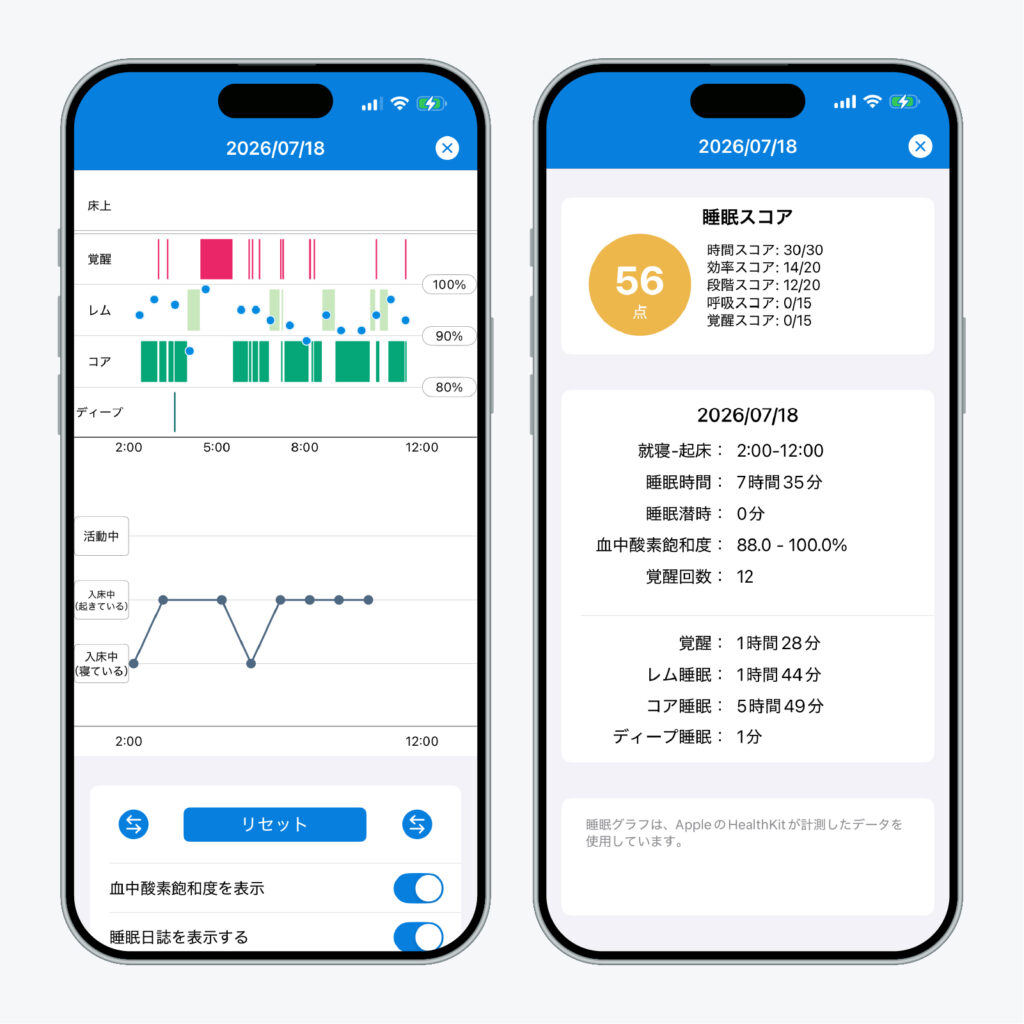
Sleepa is available in English, but some screens are still shown in Japanese. The screenshot in this article shows the Japanese version.
- It shows each night as a graph of Awake, REM, Core and Deep sleep, based on your Apple Watch data.
- Your sleep journal appears right under the graph on the same timeline, so any gap between your feeling and the data is easy to spot.
- An AI sums up trends from the last 30 days, such as your sleep time, how long it takes you to fall asleep and how often you wake up.
Sleepa does not diagnose any condition. Use it to understand your own sleep and to bring something concrete to your doctor. All features are free for 7 days from the first time you open the app. (You will not be charged automatically when the free period ends.)
Key points
- Insomnia is usually diagnosed by conversation alone, without objective data.
- As a result, sleeping pills are sometimes prescribed when they aren’t needed.
- According to Dr. Kimura, about half of insomnia is sleep state misperception, which doesn’t call for sleeping pills.
- Unnecessary sleeping pills don’t solve the problem and carry risks of side effects and dependence.
- Get an accurate diagnosis before treatment, and bring a record of your sleep to help.
- If you take sleeping pills, don’t stop on your own. Talk to your doctor.
Sources: Pharmaceuticals and Medical Devices Agency (PMDA), “Request for Proper Use of Drugs No. 11: Dependence on Benzodiazepine Receptor Agonists” (March 2017, updated May 2024; in Japanese); Health and Labour Sciences research group and Japanese Society of Sleep Research working group, “Clinical guideline for the appropriate use and discontinuation of hypnotics” (2013; in Japanese)
Sleepa — The Science of Sleep
Look back on the sleep your Apple Watch measures, together with AI sleep analysis and your sleep journal. Learn more about Sleepa.

* Requires an Apple Watch (Series 6 or later) and an iPhone with iOS 26 or later. AI text requires an iPhone that supports Apple Intelligence.
Please note: Sleepa is not a medical device. Its analysis is for reference only and is not a medical diagnosis. If you have symptoms that concern you or are worried about your sleep, please consult a medical professional.