
You open your Apple Watch sleep data in the morning and see only 20 minutes of Deep sleep. Since deep sleep is said to matter for recovery, a low number can be worrying.
Here is the short answer: a low Deep sleep reading is not necessarily a problem. Age, measurement error and normal night-to-night variation all play a part. In this article, we look at what deep sleep is, how much is enough, how to read the numbers, and what you can actually change.
About this article
This article is written by Masa, an engineer and co-founder of Medisense Inc., the company that develops the sleep app Sleepa. Medisense is led by a physician who specializes in sleep (why we built Sleepa). For the basics of Apple Watch’s four sleep stages, see How to read your Apple Watch sleep data.
What is deep sleep?
Apple Watch’s “Deep” stage corresponds to non-REM stage N3 in sleep medicine. It is also called slow-wave sleep, because the brain waves become slow and large.
- It comes early: most deep sleep happens in the first few hours after you fall asleep, and it becomes scarce toward morning.
- It is hard to wake from: as the deepest stage, it is the one in which noises are least likely to wake you.
- It supports recovery: much of the night’s growth hormone is released during the deep sleep of the first half of the night, and deep sleep is known to help consolidate what you learned during the day.
- Your body catches up: after a stretch of short nights, the next night typically brings more deep sleep than usual. The body tends to make up for lost deep sleep.
How much deep sleep is enough?
There is no fixed rule such as “you need X minutes of deep sleep.” There are two main reasons.
First, it changes a lot with age. A meta-analysis of 65 studies covering people from childhood to old age found that, even in adulthood, the share of slow-wave sleep keeps declining with age. Expecting the same amount of deep sleep in your 40s or 50s as in your 20s isn’t realistic.
Second, it differs from person to person and from night to night. For reference, in the study Apple used to validate Apple Watch (participants averaged 47 years old), deep sleep measured by lab-grade tests was about 13 percent of total sleep. That is an average for the people in the study, not a line below which something is wrong.
Apple Watch may under-count deep sleep
Apple Watch doesn’t measure brain waves. It estimates your sleep stage every 30 seconds from wrist movements, including the tiny motions caused by breathing.
According to Apple, when compared with a full lab sleep study, the most common stage mix-up is true deep sleep being labeled as Core. In other words, the Deep figure on your watch may be lower than your actual deep sleep.
A single night’s number mixes measurement error with normal variation. Rather than reacting to “only 8 minutes last night,” look at the trend over a week or so.
Things that can reduce deep sleep
If your Deep readings stay low night after night, consider whether any of these apply:
- Alcohol before bed: alcohol can actually increase deep sleep in the first half of the night, but it tends to disrupt sleep in the second half. Using a nightcap to sleep is not a good idea.
- Caffeine later in the day: in one study, caffeine taken even six hours before bed noticeably reduced sleep, and the participants didn’t realize it. It is safest to keep coffee, tea and energy drinks to earlier in the day.
- An irregular schedule: big differences between your weekday and weekend sleep times make your sleep rhythm harder to keep steady.
- Conditions that fragment sleep: in sleep apnea and similar conditions, repeated breathing disturbances break sleep into pieces, which can also reduce deep sleep.
How you feel during the day matters more than the number
More important than the amount of deep sleep is how you are during the day: whether you have strong daytime sleepiness, and whether you usually wake up feeling refreshed. If your days are fine, a low number on its own is not a reason to worry.
In fact, sleep researchers have described people whose efforts to “perfect” their sleep-tracker numbers ended up making their sleep worse. They called it orthosomnia. Use your data as a clue to understanding your sleep, not as a score to chase.
Whatever your numbers say, please see a medical professional if:
- Strong daytime sleepiness gets in the way of work, housework or driving
- You’ve been told you snore loudly or stop breathing in your sleep
- You keep waking up tired even after what should have been enough sleep
What you can change
There is no direct way to add deep sleep, but you can support your sleep as a whole.
- Get up at the same time every day: a consistent wake time, weekends included, helps keep your sleep rhythm steady.
- Keep caffeine to earlier in the day, and skip the nightcap: as above, both affect your night’s sleep.
- Move and get daylight during the day: an active day lays the groundwork for a good night.
- Don’t ride the ups and downs of one night: when you try a change, give it about a week before comparing your data.
Checking your deep sleep with Sleepa
Our sleep app, Sleepa, shows each night as a graph based on your Apple Watch data, so you can see when deep sleep happened and how much of it there was.
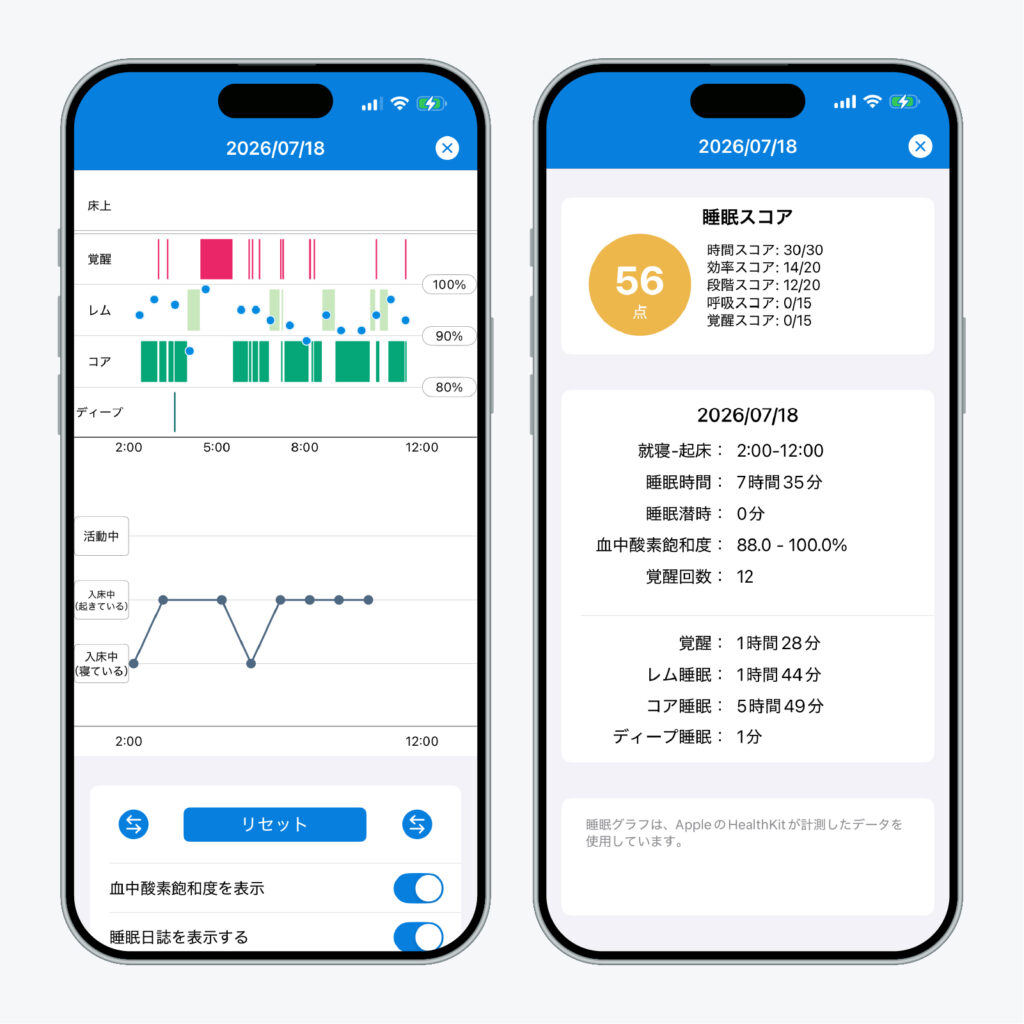
Sleepa is available in English. The screenshot in this article shows the Japanese version.
- Sleep Stages in the Sleep Score: 20 of the 100 points in Sleepa’s Sleep Score are for the balance of deep and REM sleep. Sleepa looks for at least 13 percent Deep and 18 percent REM. These are Sleepa’s own guidelines, not medical standards.
- Compare night by night: open the previous nights one after another from the dates on the home screen. If you keep the sleep journal, you can also look back at how each night felt.
- Thirty days, summed up by AI: tap Analyze, and an AI explains in a few short sentences the trends in your sleep time, how long it takes you to fall asleep, how often you wake up, and how recent nights compare with your usual (more about the AI sleep analysis).
All of Sleepa’s features are free for 7 days from the first time you open the app. (You will not be charged automatically when the free period ends.)
Sources: Apple, “Estimating Sleep Stages from Apple Watch” (updated October 2025); Ohayon MM et al., “Meta-analysis of quantitative sleep parameters from childhood to old age in healthy individuals,” Sleep 27(7), 2004; Ebrahim IO et al., “Alcohol and sleep I: effects on normal sleep,” Alcohol Clin Exp Res 37(4), 2013; Drake C et al., “Caffeine effects on sleep taken 0, 3, or 6 hours before going to bed,” J Clin Sleep Med 9(11), 2013; Baron KG et al., “Orthosomnia: Are some patients taking the quantified self too far?,” J Clin Sleep Med 13(2), 2017
Sleepa — The Science of Sleep
Look back on the sleep your Apple Watch measures, together with AI sleep analysis and your sleep journal. Learn more about Sleepa.

* Requires an Apple Watch (Series 6 or later) and an iPhone with iOS 26 or later. AI text requires an iPhone that supports Apple Intelligence.
Please note: Sleepa is not a medical device. Its analysis is for reference only and is not a medical diagnosis. If you have symptoms that concern you or are worried about your sleep, please consult a medical professional.