
You lie in bed and can’t fall asleep. You wake up again and again during the night. You wake up too early and can’t get back to sleep. About one in five adults in Japan say they struggle with sleep like this.
So what causes insomnia? In this article, we look at how medicine classifies insomnia and how common each type is. Then we share what a sleep specialist sees at the root of most insomnia, and the first steps toward treating it.
About this article
This article is written by Masa, an engineer and co-founder of Medisense Inc., the company that develops the sleep app Sleepa. It is based on what I have learned from Dr. Norihisa Kimura, who heads Medisense and specializes in sleep (board-certified neurologist; Certified Physician, Japanese Society of Sleep Research). You can read more about him in Why a sleep doctor built a sleep app.
How many people have insomnia?
In a nationwide survey of about 3,000 adults in Japan, 21.4% said they had had insomnia in the past month: 8.3% had trouble falling asleep, 15.0% woke up during the night, and 8.0% woke up too early (some people had more than one of these).
But a few bad nights do not by themselves mean you have insomnia as a medical condition. Under the international diagnostic criteria, “chronic insomnia disorder” means having trouble sleeping at least three nights a week for at least three months, even though you have enough time and a suitable place to sleep, along with problems during the day such as sleepiness, fatigue, poor concentration or low mood. Studies outside Japan find that about 6–10% of adults meet these criteria.
How medicine classifies insomnia
The current international criteria (the International Classification of Sleep Disorders, third edition, 2014) only divide insomnia by how long it has lasted: “chronic” or “short-term.” The previous edition (second edition, 2005) divided it in detail by cause. Those types are still useful for thinking about why you can’t sleep, so here are the main ones.
- Adjustment insomnia (short-term insomnia): insomnia that starts with a clear source of stress, such as problems at work or in a relationship, a move, or a family member’s illness. It usually settles once the stress is gone.
- Psychophysiological insomnia: after several bad nights, you start to worry about sleep itself (“What if I can’t sleep again tonight?”), and you tense up and feel wide awake as soon as you get into bed. It continues even after the original stress has passed.
- Paradoxical insomnia (sleep state misperception): you actually get a fair amount of sleep but feel that you hardly slept at all.
- Insomnia due to a mental health condition: insomnia that appears as one of the symptoms of depression, an anxiety disorder or a similar condition.
- Insomnia due to a physical condition: trouble sleeping because of pain, itching, coughing, getting up to use the bathroom, menopausal symptoms and so on.
- Insomnia due to medication or substances: insomnia caused by some medications, or by caffeine, alcohol, nicotine and similar substances.
- Insomnia due to daily habits: long naps, using your smartphone before bed, going to bed at a different time every night, and other habits that get in the way of sleep (called “inadequate sleep hygiene”).
- Idiopathic insomnia: insomnia with no clear cause that has continued since childhood. It is rare.
Other sleep disorders, such as sleep apnea, restless legs syndrome and disorders of the body clock (circadian rhythm sleep-wake disorders), can also show up as “I can’t sleep.”
How common is each type?
How common each type is depends on where and how it was studied. A well-known study from 1994 looked at 216 people who visited five sleep centers in the United States because of insomnia, each diagnosed by a sleep specialist. Here is what it found.
- The most common main diagnosis was insomnia related to a mental health condition such as depression (44%), followed by insomnia not caused by another condition (20%), which includes psychophysiological insomnia.
- Counting secondary diagnoses as well, more than three out of four patients (over 75%) had insomnia related to their mental and emotional state.
- Under the World Health Organization’s classification, 62% had “insomnia due to emotional causes,” while 9% had “insomnia of organic origin,” such as a physical illness.
Because the study looked at people who visited sleep centers, these figures are not the same as for everyone with insomnia. Even so, they show that insomnia linked to a person’s mental and emotional state is far more common than insomnia caused by a physical illness.
Sleep state misperception, on the other hand, needs detailed testing to confirm, so it rarely shows up in diagnoses based on interviews alone. Yet many studies have found that people with insomnia tend to feel they slept less than they actually did. Dr. Kimura believes about half of the people who see a doctor for insomnia have sleep state misperception (see What is sleep state misperception?).
A specialist’s view: anxiety is at the root of insomnia
Dr. Kimura believes that most insomnia is psychological, and that its underlying cause is anxiety.
By anxiety, he does not only mean conditions such as anxiety disorders. It can be worry about work, relationships, family, health, money or the future. And it can be worry about not being able to sleep. What people worry about differs from person to person, but the way anxiety gets in the way of sleep follows a common pattern.
How anxiety gets in the way of sleep
- Your mind and body go on alert: when you feel anxious, your heart rate goes up, your muscles tense and your mind becomes more alert. This is a natural response that prepares you for danger, but you need it to settle down before you can fall asleep. Research has shown that people with insomnia stay in this heightened state (hyperarousal), even at night.
- Not sleeping becomes a new worry: after a few bad nights, you start to worry: “What if I can’t sleep again tonight?” “This will affect my work tomorrow.” That worry keeps you even more awake, and your bed and bedroom become linked with not sleeping. When insomnia continues after the original stress has passed, this vicious cycle is often the reason.
- Sleep feels shorter than it was: the more you worry about whether you are sleeping, the more likely you are to notice brief awakenings in the night, and to feel that you were awake during time you actually spent asleep. This kind of worry is thought to lie behind sleep state misperception, too.
- It is a symptom of mental health conditions: insomnia is one of the most common symptoms of depression and anxiety disorders.
Whatever first triggered it, what keeps insomnia going is often anxiety. Sleeping pills can help you sleep, but they do not remove the anxiety itself. That is why sleeping pills alone sometimes fail to solve the problem (see Before you take sleeping pills).
So where should treatment begin? Dr. Kimura believes two things matter most.
First step 1: get to know your sleep in detail
The first is to find out, in detail, how you are actually sleeping.
As we have seen, there are many types of insomnia, and each needs different treatment. Are you really not getting enough sleep? Are you sleeping but feeling that you are not? Or is another condition, such as sleep apnea, behind it? To tell these apart, the feeling of “I can’t sleep” is not enough. What your sleep actually looks like is an important clue.
Knowing your sleep accurately can also ease anxiety in itself. You thought you hardly slept, but your records show you actually got a fair amount of sleep. For many people, just learning this makes the worry about sleep feel lighter.
Clinical guidelines from the American College of Physicians (2016) and the European Sleep Research Society (2017, updated in 2023) recommend cognitive behavioral therapy for insomnia (CBT-I) as the first treatment for chronic insomnia, before medication. CBT-I also starts by recording your sleep every day in a sleep diary and getting to know it in detail.
It helps to record two things: a sleep diary, where you write down each morning how you felt you slept, and the sleep actually recorded by a wearable such as an Apple Watch. We explain how in Check your sleep in one week.
That said, focusing too much on the numbers can become a new source of anxiety. Your records are not there to make you blame yourself or worry. They are there to help you understand yourself and talk things over with your doctor.
First step 2: face the causes of your anxiety
The second is to face what is causing the anxiety inside you. Dr. Kimura believes that treating insomnia means looking at the anxiety a person is carrying, not just trying to fix their sleep.
How you do this differs from person to person. Here are some approaches.
- Put your worries into words: when worries only go round in your head, they feel bigger than they are. Writing them down on paper helps you see what you are actually worried about. If your thoughts keep racing once you are in bed, try setting aside about 15 minutes in the early evening to write down your worries and the next step you can take for each.
- Rethink your beliefs about sleep: thoughts like “I must sleep eight hours” or “If I don’t sleep tonight, I won’t be able to do anything tomorrow” can make anxiety worse. How much sleep people need varies, and the amount of sleep people actually get also decreases with age. Even after a bad night, most people manage to get through the next day.
- Break the link between your bed and worry: if you spend a long time lying awake in bed, your bed becomes linked with anxiety. CBT-I breaks this link with methods such as going to bed only when you feel sleepy, and getting out of bed to do something calm when you can’t sleep.
- Don’t carry it alone: the cause of your anxiety may be something that can’t be solved right away, such as a problem at work or at home. Talking to someone you trust, or to a professional such as a doctor or counselor, is also an important way to face it. CBT-I is offered at sleep clinics and by mental health professionals, but it is not available everywhere, so it is worth checking before you book.
When to see a doctor soon
In the following cases, anxiety may not be the cause. Please see a doctor soon.
- Someone has told you that you snore loudly or stop breathing while you sleep
- In the evening or at night, your legs feel so uncomfortable that you can’t keep them still
- You have felt low, or unable to enjoy anything, for two weeks or more
- Strong sleepiness during the day is affecting your work or driving
- You keep sleeping poorly and it is affecting your daily life
If you are going through a hard time emotionally, please don’t carry it alone. Reach out to a doctor early. If you have sleep records, they will give you something concrete to talk about.
How Sleepa can help
We built our sleep app, Sleepa, so you can take the first step, getting to know your sleep in detail, as part of your daily life.
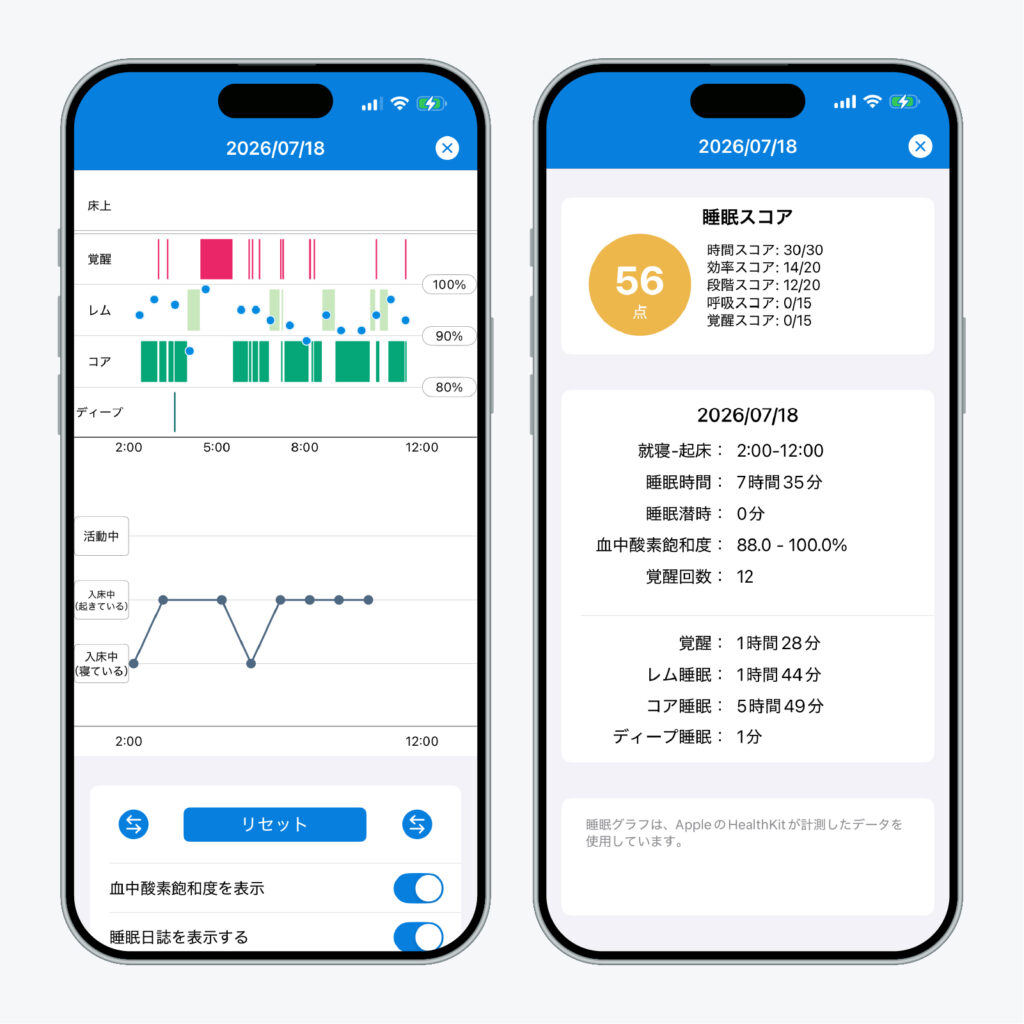
Sleepa is available in English, but some screens are still shown in Japanese. The screenshot in this article shows the Japanese version.
- It shows each night as a graph of Awake, REM, Core and Deep sleep, based on your Apple Watch data.
- Your sleep journal appears right under the graph on the same timeline, so any gap between how you felt you slept and how you actually slept is easy to spot (more about the sleep journal).
- An AI sums up trends from the last 30 days, such as your sleep time, how long it takes you to fall asleep and how often you wake up (more about the AI sleep analysis).
Sleepa does not diagnose any condition. Use it to understand your own sleep and to bring something concrete to your doctor. All features are free for 7 days from the first time you open the app. (You will not be charged automatically when the free period ends.)
Key points
- About one in five adults in Japan has trouble sleeping; about 6–10% of adults meet the criteria for insomnia disorder
- There are many types of insomnia, including short-term insomnia, psychophysiological insomnia, sleep state misperception, and insomnia due to mental or physical health conditions
- In a study at sleep centers, more than three out of four patients had insomnia related to their mental and emotional state
- Dr. Kimura believes most insomnia is psychological, and that its underlying cause is anxiety
- The first steps in treatment are getting to know your sleep in detail and facing the causes of your anxiety
- See a doctor soon if you snore or stop breathing in your sleep, or if low mood continues
Sources: Kim K, et al. “An epidemiological study of insomnia among the Japanese general population.” Sleep 23(1), 2000; American Academy of Sleep Medicine. “International Classification of Sleep Disorders, 3rd ed.” 2014; Morin CM, Jarrin DC. “Epidemiology of insomnia: prevalence, course, risk factors, and public health burden.” Sleep Med Clin 17(2), 2022; Buysse DJ, et al. “Clinical diagnoses in 216 insomnia patients using the International Classification of Sleep Disorders (ICSD), DSM-IV and ICD-10 categories.” Sleep 17(7), 1994; Riemann D, et al. “The hyperarousal model of insomnia: a review of the concept and its evidence.” Sleep Med Rev 14(1), 2010; Spielman AJ, et al. “A behavioral perspective on insomnia treatment.” Psychiatr Clin North Am 10(4), 1987; Harvey AG. “A cognitive model of insomnia.” Behav Res Ther 40(8), 2002; Harvey AG, Tang NKY. “(Mis)perception of sleep in insomnia: a puzzle and a resolution.” Psychol Bull 138(1), 2012; Qaseem A, et al. “Management of chronic insomnia disorder in adults: a clinical practice guideline from the American College of Physicians.” Ann Intern Med 165(2), 2016; Riemann D, et al. “The European Insomnia Guideline: an update on the diagnosis and treatment of insomnia 2023.” J Sleep Res 32(6), 2023
Sleepa — The Science of Sleep
Look back on the sleep your Apple Watch measures, together with AI sleep analysis and your sleep journal. Learn more about Sleepa.

* Requires an Apple Watch (Series 6 or later) and an iPhone with iOS 26 or later. AI text requires an iPhone that supports Apple Intelligence.
Please note: Sleepa is not a medical device. Its analysis is for reference only and is not a medical diagnosis. If you have symptoms that concern you or are worried about your sleep, please consult a medical professional.